

Black holes might conceal unseen formations that can only be detected through subtle alterations in gravitational waves. Researchers at Nagoya University have introduced a novel approach to investigate the potential existence of “black hole hair” by analyzing the variations in signals following black hole mergers.
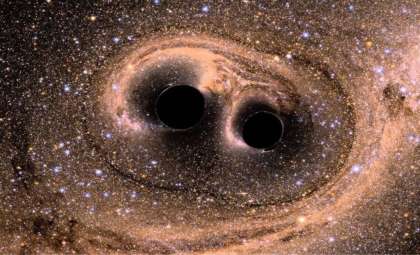
When two black holes combine, they form a new entity that emits gravitational waves before stabilizing. This process, called the “ringdown” phase, resembles the dissipating tone of a bell and may carry vital information about the surrounding environment of a black hole.
According to Einstein’s general relativity, black holes are characterized by just a few parameters such as mass and spin. Yet, there has been speculation about whether additional factors, like concealed matter or novel physical phenomena, might subtly influence their behavior.

This speculative additional structure, often referred to as “black hole hair” in theoretical physics, has now been studied by Nagoya University scientists through modifications in gravitational wave patterns that could reveal such hidden features around black holes.
Examining the Environment Around Black Holes
Following the merger of two black holes, the resultant black hole emits gravitational waves that gradually diminish in intensity. Scientists focus on this ringdown phase because it encodes details about the properties of the newly formed black hole.
For a typical black hole described by Einstein’s field equations, the signal is primarily determined by its mass and angular momentum. However, if there is surrounding matter, it could affect the wave characteristics, producing a distinct signature.
The study featured in the Journal of Cosmology and Astroparticle Physics reveals that hidden matter impacts different components of the ringdown signal unequally. Specifically, the wave’s frequency and decay rate may alter to varying extents.

These disparities offer a promising avenue for detecting hidden matter around black holes, potentially revealing its quantity and pressure distribution in the vicinity.
The researchers also explored cases involving spinning black holes. Here, the influence of hidden matter on gravitational waves varies depending on whether the waves propagate with or against the black hole’s rotation.
Advancing Tests of Einstein’s Gravity Theory
The hunt for black hole hair connects with a key question in physics: does Einstein’s general relativity fully describe phenomena in the universe’s most extreme conditions?
Black holes dramatically warp spacetime, impacting the paths of both light and gravitational waves. Their intense gravitational fields make them unique laboratories for probing possible unknown physics or the presence of additional matter.
The team’s method leverages a known relationship between light’s orbit around a black hole and the properties of ringdown waves. By introducing small amounts of hidden matter into theoretical black hole models, they calculated alterations in the gravitational wave signals using Einstein’s equations.
The researchers tested this framework with three theoretical scenarios, expanding it later to rotating black holes. They further compared light traveling in alignment or opposition to the black hole’s spin. Ariadna Uxue Palomino Ylla, a Ph.D. candidate at Nagoya University and lead author, remarked:
“Black hole hair may represent matter surrounding the black hole or deviations from the simplest kind of black hole predicted by general relativity. Because these may slightly change the ringdown signal, detecting or ruling out these changes could give us a new way to test gravity in this extreme region.”
Detecting Hidden Matter Through Gravitational Waves
A key outcome from the analysis is that the gravitational wave frequency and damping rate respond differently in the presence of hidden matter. This variation depends on both the quantity and pressure profile of the concealed material around the black hole.
Rather than dissecting every form of black hole hair individually, this new technique offers a comprehensive strategy to gauge how extra matter or novel physical influences might modify gravitational waveforms. This could enable researchers to spot distinct patterns in upcoming gravitational wave data, distinguishing ordinary black holes from those embedding additional structures.
“The ringdown waves may not only show that something extra is affecting the black hole; the way the signal changes could also give us clues about what this hidden matter is actually like,” said Ariadna Uxue Palomino Ylla.

The authors emphasize that their findings do not confirm the presence of black hole hair but rather provide a novel analytical tool to explore possible surrounding structures and test if black holes might exhibit features beyond current theoretical predictions.
- Categories:
- Space






0 comments
Sign in to Comment