

Astronomers have identified HD 176071 b, an extraordinary exoplanet abundant in water, orbiting extremely close to its sun. Gravitational tidal forces are steadily altering this oceanic world's trajectory, steering it toward a future collision with its star.
Situated about 335 light-years away, this planet offers a unique glimpse into planetary types rarely observed. Measuring roughly 2.5 times Earth’s diameter and possessing nearly 8.5 times Earth’s mass, it is estimated that around half of its mass comprises water.
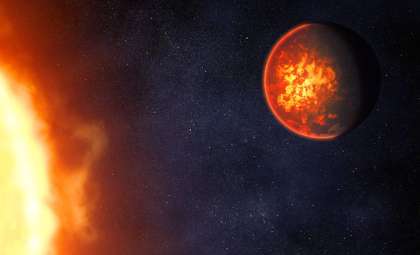
Classified as part of the rare group known as hot water worlds, HD 176071 b orbits exceptionally close to its star, completing each revolution in a mere 14 hours at a distance less than 1.5 million miles—approximately 1.6% of the Earth-Sun gap.

Survival of a Water-Dominated World in Close Stellar Orbit
The close proximity between HD 176071 b and its star results in intense gravitational effects, or tidal forces, which progressively modify the planet’s path, inevitably leading it toward its star.
This planet resides within the Neptunian Desert, a stellar neighborhood typically devoid of Neptune-sized planets, likely due to extreme radiation stripping away their atmospheres.
Published on August 25 in Astronomy & Astrophysics, the study reveals HD 176071 b defies these norms. Even under potent stellar radiation, it sustains a dynamic atmosphere, marked by changing, reflective clouds forming and moving across its cooler surface areas.
Researchers reached these insights by comparing archival data from the Kepler Space Telescope with fresh measurements gathered six years later from NASA’s TESS mission. This comparison uncovered an unexpected shift in the planet’s reflective light patterns.
Unveiling a Planet Elusive to Transit Techniques

The majority of exoplanets discovered to date have been found using the transit method, which identifies planets by observing dips in stellar brightness when they pass in front of their star as seen from Earth.
Because HD 176071 b does not transit its star from our vantage point, this common approach is ineffective. Instead, astronomers detected variations in the reflected starlight as the planet moves along its orbit.

This planet is tidally locked, so its star-facing side perpetually basks in light, while the opposite hemisphere remains shrouded in darkness. As it orbits, different portions come into view from Earth, causing shifts in observed reflected brightness.
Using data from the HARPS-N instrument mounted on the Galileo National Telescope, scientists captured these subtle brightness changes with exceptional accuracy. This approach enabled them to detect the planet and gain insights into its atmospheric and internal characteristics.
Innovative Approach to Exploring Remote Exoplanets
This discovery highlights how planets undetectable by conventional methods can be studied effectively by analyzing their reflected light in detail.
“Comparing historical data from the Kepler space telescope with new TESS observations six years later, we noticed an unexpected phase shift in the modulation of the reflected light,” said Sylvain N. Breton from the Italian National Institute of Astrophysics (INAF).

Breton noted that the observations indicate a dynamic planetary environment rather than static atmospheric conditions. This world features cloud systems that form, shift, and drift along its frigid zones.
- Categories:
- Space








0 comments
Sign in to Comment