

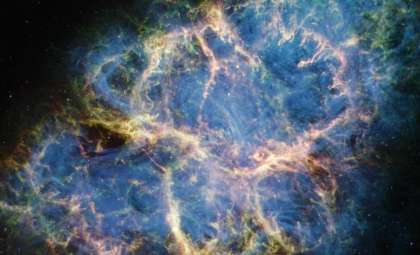
Astrophotographer Kevin Boardman has created a stunning deep-space portrait of the Crescent Nebula, exposing delicate gas filaments encircling a massive star nearing the end of its lifecycle. His dedicated 16-hour imaging session uncovers the turbulent activity sculpting this stellar bubble situated approximately 4,700 light-years away in the constellation Cygnus.
The focus of the image is WR 136, also known as HD 192163, a Wolf-Rayet star shining as a vivid blue point near the nebula's core. These uncommon, supermassive stars emit intense stellar winds capable of reshaping their cosmic environments by expelling gas and stellar debris.
Known by the designations NGC 6888 and Caldwell 27, the Crescent Nebula derives its name from its crescent form when viewed through specific light wavelengths. According to NASA, this expansive 25-light-year-wide bubble formed from material cast off by WR 136 as it transitioned into a red giant.

The nebula’s current structure results from dramatic interactions. Initial material ejected by the star was later struck by faster stellar winds, producing shockwaves that molded the intricate shell and glowing filaments caught in Boardman’s photograph.
Creation of a Cosmic Shell Driven by Stellar Evolution
The star’s relentless winds channel expelled gas into a vast, elaborate formation. Far from a simple leftover cloud from a dying star, the Crescent Nebula's appearance has been sculpted by collisions between successive layers of ejected material. When newer, faster winds collided with older gas, powerful shockwaves compressed and reshaped the expanding shell.
Data from NASA reveals that the nebula originated from matter shed by WR 136 during its red giant phase. The ongoing impact of rapid stellar winds continues to produce the intricate gaseous patterns seen across the nebula's expanse.

At the core, WR 136 keeps illuminating the surrounding gas, offering astronomers vital insights into stellar wind dynamics and environmental transformations around an aging, massive star.
Hours of Imaging Reveal a Delicate Cosmic Web
Capturing detailed views of the Crescent Nebula involved an extensive photography effort. Kevin Boardman gathered data across five nights in late July, dedicating 16 hours and 18 minutes to imaging the nebula.
He employed narrowband filters tuned to specific wavelengths emitted by ionized gases. This method enhances subtle structures within the nebula and differentiates the chemical elements composing its glowing shell.
“In the image, orange-red H-alpha reveals the tangled filaments while blue-cyan [O III] outlines emission from doubly ionized oxygen around the shell,” Boardman told Space.com in an email.

Nearly 12 hours of narrowband imaging concentrated on the nebula itself, with an additional four hours and 20 minutes spent on capturing nearby stars. These exposures were combined using PixInsight software for post-processing.
The resulting image vividly contrasts the nebula’s gases: hydrogen-alpha emissions appear as warm orange-red filaments, while doubly ionized oxygen generates cool blue-cyan highlights tracing the shell’s boundary.
Locating the Subtle Crescent Nebula in the Night Sky
Though breathtaking in photographs, the Crescent Nebula is too faint for unaided human vision. Observing it requires a telescope of moderate to large size, ideally fitted with light pollution reduction filters.
Situated in the constellation Cygnus, it becomes accessible during late summer when Cygnus ascends high in the northern sky. The bright star Sadr (magnitude +2.34) serves as a helpful guide, resting near the center of Cygnus’ distinctive cross shape.

From Sadr, stargazers can move toward Eta Cygni, a dimmer star with a magnitude of +4.03. The Crescent Nebula lies between these stars and can be pinpointed using basic star maps or astronomy apps. Space.com notes the best viewing occurs around new moon nights, like September 10–11, when diminished moonlight enhances the visibility of faint celestial wonders.
- Categories:
- Space



0 comments
Sign in to Comment