

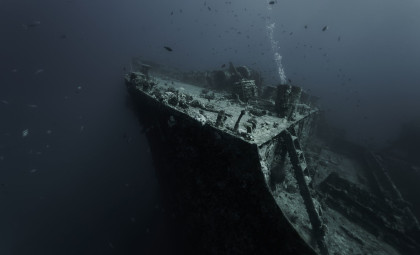
Initially perceived as a small signal on sonar, the object spotted by Polish divers in the Baltic Sea could have been mistaken for a fishing vessel. After completing an earlier dive that day, Marek Cacaj and Pawel Truszynski decided to investigate once more.
What started as a quick assessment evolved into nearly two hours underwater. At around 60 meters deep, about 20 nautical miles northwest of Sweden’s Öland Island, they uncovered a remarkably well-preserved 19th-century sailing ship. Cacaj later noted the only visible damage was limited to the bow.
The discovery became more extraordinary when the divers found bottles inside the ship.


The ship’s hold was filled with luxury items such as porcelain, mineral water, and wine, along with over 100 champagne bottles, as detailed by the Baltictech diving team. Approximately 100 sealed clay mineral water bottles were also found. What initially seemed to be a modest wreck turned into a unique glimpse of 19th-century high-end Baltic trade.
Mineral Water Bottles Provide Key Dating Clues
While the champagne was the standout find, other cargo offered clues to pinpoint the ship's sinking timeframe.
Photographs of clay bottles showed labels from Selters, a renowned German mineral water brand. Collaborating with historians, the team analyzed the Selters stamps, dating them between 1850 and 1867.
This narrows down the rough estimate of the bottles’ age. Baltictech’s evidence suggests the mineral water shipment dates to 1850-1867. Although the shipwreck and contents are identified as 19th century, no exact sinking date has been confirmed.

The mineral water was more than just a luxury refreshment. According to the team, at the time, such mineral water was prized by affluent patrons and used medicinally. Cacaj explained to Reuters that these shipments sometimes warranted police or military escorts. Baltictech added that the product was served at royal dining tables.
The combination of champagne, porcelain, and mineral water paints a clear picture of cargo intended for an upscale clientele, whatever the ship’s ultimate destination.
Uncertain Links to the Russian Tsar
The ship’s exact cargo destination remains speculative beyond the timeframe indicated by the mineral water.
Cacaj told Reuters that they had identified the champagne maker and initiated contact. He mentioned it was a rare vintage and that the producer had crafted a sweeter champagne variety specifically for the Russian tsar. Based on this, Cacaj suggested the shipment was likely heading to Russia.
This interpretation by the divers is yet unconfirmed since no shipping manifests or records reveal the ship’s route. Earlier reports allowed for the possibility that goods might have been destined for royal households in Stockholm or St. Petersburg.

The state of the champagne is an intriguing question. If permission to retrieve the bottles is granted, the team intends to send samples to the producer to assess value and determine if the wine remains potable. Current reports do not confirm the drinkability of the liquid inside.
Wreck Recovery Faces Legal and Logistical Challenges
Discovering the cargo is only the first step; removing it presents a greater challenge. Since the wreck is situated in Swedish territorial waters, the Polish divers must obtain authorization before any artifacts can be salvaged. The Swedish authorities were notified following the discovery.
Baltictech also reached out to the MARIS Foundation, Södertörn University, and professor Johan Rönnby for guidance on how best to proceed with investigating the site. Rather than starting an immediate recovery, the team has received recommendations for a controlled, scholarly exploration.
For Tomasz Stachura, leader of Baltictech, the volume of cargo sets this find apart from decades of diving experience. He shared with The Guardian that despite 40 years diving, encountering such an extensive cargo in a single wreck was unprecedented.
- Categories:
- News








0 comments
Sign in to Comment