

At an archaeological site near Rajghat, in Varanasi, India, a collection of boxes containing artifacts sat undisturbed for decades within the archives of Banaras Hindu University. These boxes hold a vast number of objects, tracing back to a settlement area dating roughly three millennia ago.
This past summer, the university embarked on a project to catalog and study these long-forgotten artifacts. Among them, 22 boxes alone contained more than 10,000 pieces, including painted black ware pottery from around 3,000 years ago, sculptures, coins, toolkits, seals, and various objects crafted from copper, ivory, and bone, as reported by the Indian Express.
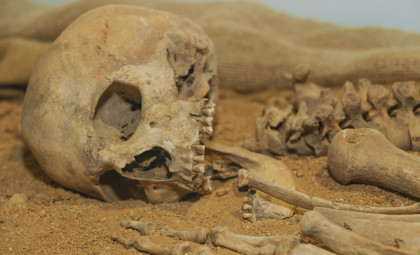
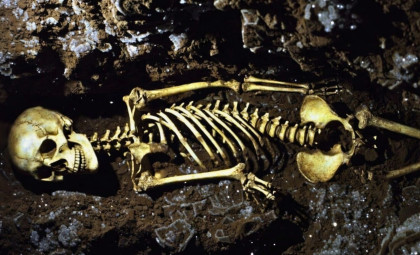
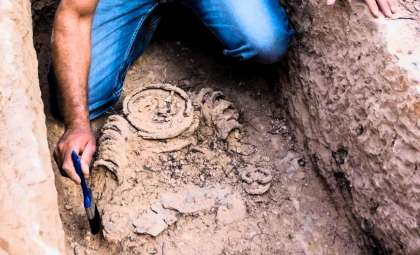
One box stood out for its uniqueness: it held a human skeleton excavated from the Rajghat site and preserved untouched for decades. Scientists are now planning to extract ancient DNA from the skeletal remains to conduct both genetic and bio-archaeological research.

Based on a statement from BHU outlining the upcoming genetic studies, the researchers seek to deepen understanding of the biological origins of the ancient inhabitants from the site’s era.

The current research revisits the excavation initially completed in the 1950s. Although Rajghat has been studied for many years, the new initiative by BHU focuses on systematically organizing older collections and applying advanced analytical techniques that were unavailable during original digs.
Settlement Layers Trace Back to Circa 800 B.C.
Located near where the Ganga and Varana rivers meet, Rajghat is linked historically with ancient Varanasi.
Archaeologist Vidula Jaiswal, formerly affiliated with BHU, identifies Rajghat as the capital hub of the Kashi Janapada, an ancient political region in India. Her research established Rajghat as a significant urban center, distinguishing it from Sarnath, which developed more as a religious site.
In 1957, BHU archaeologist A K Narain and his team launched excavations at three mounds in Rajghat. The excavation proceeded through four phases over twelve years.
The deepest layers revealed pre-Northern Black Polished Ware pottery, signaling an earlier Iron Age. This placed the initial settlement around 800 B.C..
Years later, Jaiswal and archaeologist B R Mani revisited the lower strata. Their early 2000s re-examination included scientific tests that reaffirmed the circa 800 B.C. dating of Rajghat’s earliest habitation.
The site’s historical sequence extends beyond this period. Archaeologists divide Rajghat’s timeline into multiple cultural eras reaching into the medieval age.
Among the excavated materials are hundreds of seals and sealings. Some bear the inscription "Varanasi," firmly linking Rajghat to the ancient city. According to Mahesh Prasad Ahirwar, head of BHU’s Ancient Indian History, Culture and Archaeology department, certain seals feature Greek characters alongside names of administrative sectors or officials. Additional inscriptions have been found in Brahmi script.
Vast Archive of Photographs Supports the Collection
The archives offer more than just artifacts like pottery and coins.
BHU has also preserved approximately 3,000 glass slides and over 5,000 photographic negatives, which document archaeological sites such as Rajghat, Manjhi, Ajanta, Ellora, and Ratnagiri. These images capture sculptures and religious icons as they appeared decades ago.
Currently, three expert teams are dedicated to preserving and cataloging these materials. There is some urgency, as the storage trunks have significantly degraded, noted Ahirwar.
Beginning in January as part of centenary celebrations, the department has so far documented about 4,000 artifacts by September.
BHU has intentions to expand access to these collections for scholarly work, with plans to establish a museum. Meanwhile, the excavation findings continue to be publicly accessible.
Genetic Study of a Unique Skeleton Opens New Pathways
The human skeleton introduces a unique research opportunity.
Estimated to be around 1,000 years old, the skeletal remains have yet to yield finalized genetic results or updated dating. Samples collected for DNA and bio-archaeological testing aim to uncover insights into the populations inhabiting the middle Ganga Valley during that period.
Ahirwar explained that DNA analysis can reveal data about the individual’s age, heritage, and lifestyle.
However, these prospects remain goals; definitive findings from the Rajghat skeleton study have not yet been published.
An earlier report claimed that 22 boxes remained unopened for nearly seven decades.
The more recent Explained article clarifies the situation: while excavation reports and some artifacts were always accessible to researchers, this marks the first comprehensive effort to catalog the entire collection, with the human skeleton box being the only one truly opened for the first time.
- Categories:
- Science



0 comments
Sign in to Comment